
Uncategorized
now browsing by category
NFP in focus 8/01/2016.
The Non-Farm Payrolls which show employment changes across 10 private labor market sectors is watched closely by markets eager to gauge the health of the economy. Investors are well aware that the Fed’s policies in the coming months will depend on significant indicators like labor market data and inflation report. Robust non-farm data signals tightening of the labor market which in turn signifies a strong economic outlook.
If the December non-farm payroll data is stronger than what is being expected then the possibility of the Fed raising rates for a second straight time in end January will increase.
Technical levels for majors.
EUR/USD
| S3: 1.0798 | S2: 1.0825 | S1: 1.0852 | R1: 1.1023 | R2: 1.1051 | R3: 1.1078 |
GBP/USD
| S3: 1.4450 | S2: 1.4486 | S1: 1.4523 | R1: 1.4633 | R2: 1.4669 | R3: 1.4706 |
USD/CHF
| S3: 0.9794 | S2: 0.9818 | S1: 0.9843 | R1: 1.0006 | R2: 1.0031 | R3: 1.0056 |
Technical update for 7/01/2016.
After the hint given by FED for successive rate hike in the year 2016 would have dovish impact on US dollar.
A dovish rate hike is what the market is expecting but for now there are trading opportunities which we have to consider.
Outlook for today is for long position on EUR/USD, GBPUSD, EURJPY.
TECHNICAL LEVELS ARE AS FOLLOWS
EUR/USD
| S3: 1.0697 | S2: 1.0724 | S1: 1.0751 | R1: 1.0836 | R2: 1.0863 | R3: 1.0890 |
GBP/USD
| S3: 1.4502 | S2: 1.4539 | S1: 1.4575 | R1: 1.4657 | R2: 1.4694 | R3: 1.4730 |
EUR/JPY
| S3: 126.19 | S2: 126.51 | S1: 126.82 | R1: 128.01 | R2: 128.33 | R3: 128.65 |
New year full of big trades 6/01/2016
The year 2016 is about to change some major direction in the market.
Last year was full of ups and downs.
naming a few key events like CHF -rate change which shocked the market.
china changing there trade policy, ECB changing there deposit rate and US much awaited rate hike.
these where the few key events changing the market. it was observed that there was lot of divergence in the market where the currency pairs where operating in different direction.
CURRENCY PAIRS TO LOOK OUT FOR.
USD/CHF
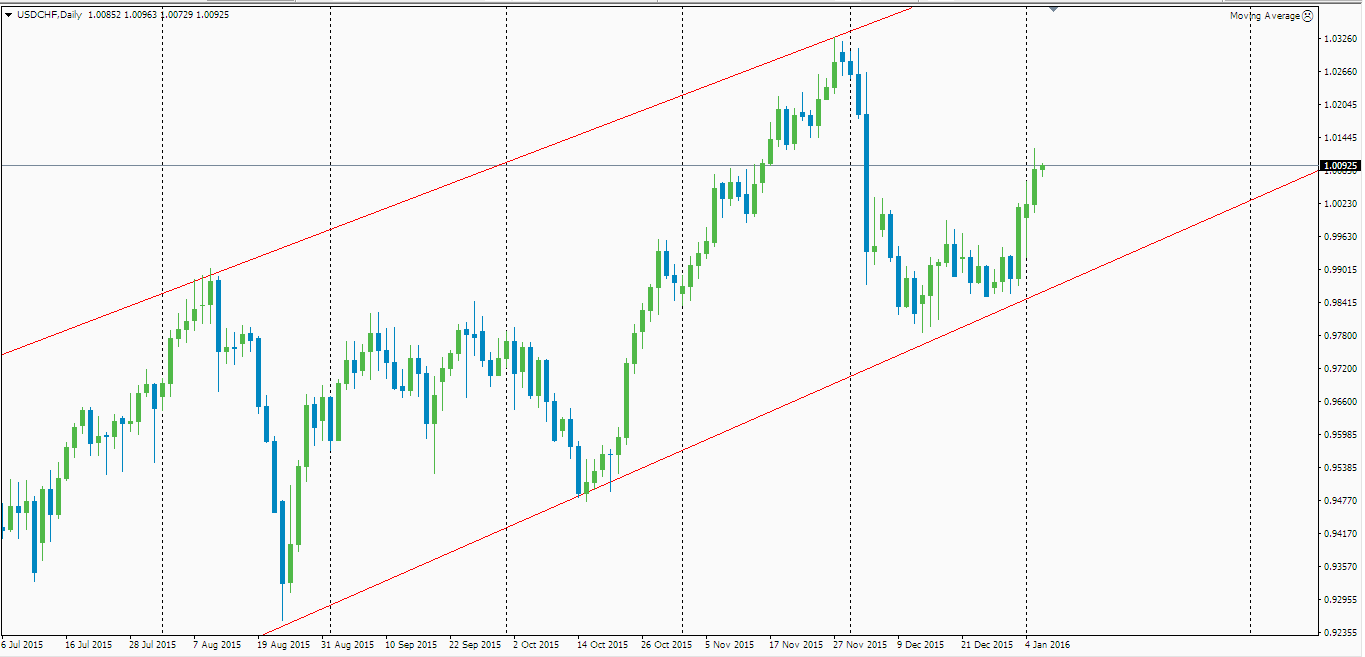
This is one of the few currency pairs which has good potential for upside.
Long term position should be considered for buy and buy on dip would amplify the profits.
targets for the currency pair would be given in further posts.
GBP/USD
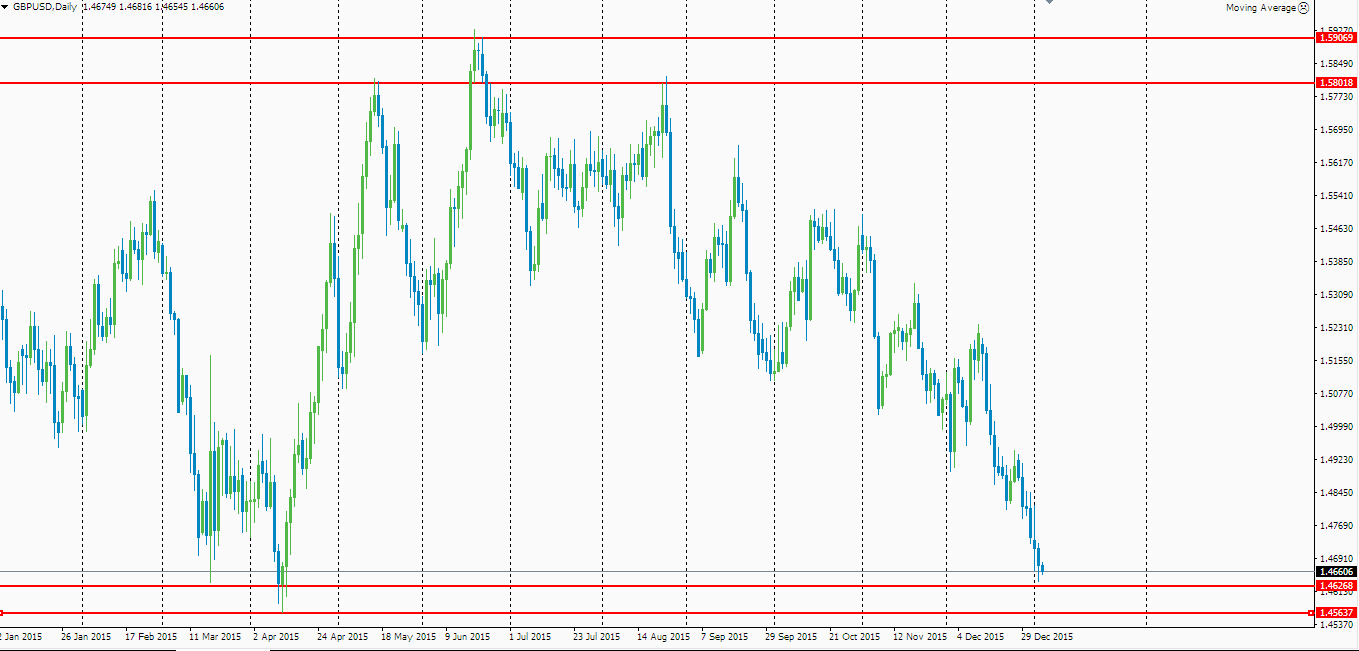
Pound trading at low near 1.4650 trying to test last year march low of 1.4567.
although the pair is at the support are but it seem to be trading in box for quite a few years now.
as major change in financial policy is what is need to break though this box rage.
pound feeling the pressure as the economic data continues to weaken and much pressurized by US dollar demand.
trading levels for cable would be given in the next post.
95% traders lose money … is that statistics true?
Scientist have discovered the facts about trading.
“95% of all traders fail” is the most commonly used trading related statistic around the internet. But no research paper exists that proves this number right. Research even suggests that the actual figure is much, much higher. In the following article we’ll show you 24 very surprising statistics economic scientists discovered by analyzing actual broker data and the performance of traders. Some explain very well why most traders lose money.
- 80% of all day traders quit within the first two years. 1
- Among all day traders, nearly 40% day trade for only one month. Within three years, only 13% continue to day trade. After five years, only 7% remain. 1
- Traders sell winners at a 50% higher rate than losers. 60% of sales are winners, while 40% of sales are losers.2
- The average individual investor under performs a market index by 1.5% per year. Active traders under perform by 6.5% annually. 3
- Day traders with strong past performance go on to earn strong returns in the future. Though only about 1% of all day traders are able to predictably profit net of fees. 1
- Traders with up to a 10 years negative track record continue to trade. This suggest that day traders even continue to trade when they receive a negative signal regarding their ability. 1
- Profitable day traders make up a small proportion of all traders – 1.6% in the average year.However, these day traders are very active – accounting for 12% of all day trading activity. 1
- Among all traders, profitable traders increase their trading more than unprofitable day traders. 1
- Poor individuals tend to spend a greater proportion of their income on lottery purchases and their demand for lottery increases with a decline in their income. 4
- Investors with a large differential between their existing economic conditions and their aspiration levels hold riskier stocks in their portfolios. 4
- Men trade more than women. And unmarried men trade more than married men. 5
- Poor, young men, who live in urban areas and belong to specific minority groups invest more in stocks with lottery-type features. 5
- Within each income group, gamblers under perform non-gamblers. 4
- Investors tend to sell winning investments while holding on to their losing investments. 6
- Trading in Taiwan dropped by about 25% when a lottery was introduced in April 2002. 7
- During periods with unusually large lottery jackpot, individual investor trading declines. 8
- Investors are more likely to repurchase a stock that they previously sold for a profit than one previously sold for a loss. 9
- An increase in search frequency [in a specific instrument] predicts higher returns in the following two weeks. 10
- Individual investors trade more actively when their most recent trades were successful.11
- Traders don’t learn about trading. “Trading to learn” is no more rational or profitable than playing roulette to learn for the individual investor.1
- The average day trader loses money by a considerable margin after adjusting for transaction costs.
- [In Taiwan] the losses of individual investors are about 2% of GDP.
- Investors overweight stocks in the industry in which they are employed.
- Traders with a high-IQ tend to hold more mutual funds and larger number of stocks. Therefore, benefit more from diversification effects.
Conclusion: Why Most Traders Lose Money Is Not Surprising Anymore
After going over these 24 statistics it’s very obvious to tell why traders fail. More often than not trading decisions are not based on sound research or tested trading methods, but on emotions, the need for entertainment and the hope to make a million dollars in your underwear. What traders always forget is that trading is a profession and requires skills that need to be developed over years. Therefore, be mindful about your trading decisions and the view you have on trading. Don’t expect to be a millionaire by the end of the year, but keep in mind the possibilities trading online has.
End of the year.. 28/12/2015..
A typical holiday-thinned trading is witnessed in Asia so far, with most traders still on the side-lines on the back of Christmas-New Year holiday season. The Australian, New Zealand and the major European markets remain closed in observance of Boxing Day holiday. Hence, low volumes and irregular volatility is expected to remain in the week ahead.
Calendar-wise, we had a set of poor Japanese economic data released earlier today, which dragged the yen lower against its American counterpart. The USD/JPY pair partially reversed last week’s losses and edged marginally higher around 120.40, with the upside still capped by broad based USD weakness. Industrial production in Japan was down a seasonally adjusted 1.0% m/m in November, missing forecasts for a decline of 0.5% following the 1.4 percent gain in October. While the total value of retail sales in Japan was down 1.0% on year in November.
While the Antipodeans remain supported amid illiquid markets and shrug off lower commodities’ prices as markets continue to mull over Fed’s lift-off and the latest Chinese industrial profits data released over the weekend. The Chinese industrial profits fell 1.4% in Nov from a year earlier, compared with 4.6% for last month, marking a sixth consecutive month of decline.
BOJ MONETARY POLICY 18/12/2015.
BANK OF JAPAN Keeps monetary policy steady, pledges to increase monetary base at annual pace of 80 trln Yen
To increase purchases of etfs
To create new programme to buy etfs
To extend average duration of JGB purchases to 7-12 years
Will buy etfs at annual pace of about 300 bln Yen under new programme in addition to current etf buying
To expand loan scheme aimed at firms with growth potential
To start selling stocks it purchased from financial institutions from April next year
Will purchase etfs composed of stocks issued by firms active in investment in capex, human resources
New etf programme will start with purchases of etfs that track jpx-nikkei index 400
Vote on etfs was 6 to 3
Extends growth lending facilities by 1 year
Bank of Japan keeps economic assessment unchanged
$$$$$FED HIKE $$$$$
- The Board of Governors of the Federal Reserve System voted unanimously to raise the interest rate paid on required and excess reserve balances to 0.50 percent, effective December 17, 2015.
- As part of its policy decision, the Federal Open Market Committee voted to authorize and direct the Open Market Desk at the Federal Reserve Bank of New York, until instructed otherwise, to execute transactions in the System Open Market Account in accordance with the following domestic policy directive:1“Effective December 17, 2015, the Federal Open Market Committee directs the Desk to undertake open market operations as necessary to maintain the federal funds rate in a target range of 1/4 to 1/2 percent, including: (1) overnight reverse repurchase operations (and reverse repurchase operations with maturities of more than one day when necessary to accommodate weekend, holiday, or similar trading conventions) at an offering rate of 0.25 percent, in amounts limited only by the value of Treasury securities held outright in the System Open Market Account that are available for such operations and by a per-counterparty limit of $30 billion per day; and (2) term reverse repurchase operations to the extent approved in the resolution on term RRP operations approved by the Committee at its March 17-18, 2015, meeting.
The Committee directs the Desk to continue rolling over maturing Treasury securities at auction and to continue reinvesting principal payments on all agency debt and agency mortgage-backed securities in agency mortgage-backed securities. The Committee also directs the Desk to engage in dollar roll and coupon swap transactions as necessary to facilitate settlement of the Federal Reserve’s agency mortgage-backed securities transactions.”
- In a related action, the Board of Governors of the Federal Reserve System voted unanimously to approve a 1/4 percentage point increase in the discount rate (the primary credit rate) to 1.00 percent, effective December 17, 2015. In taking this action, the Board approved requests submitted by the Boards of Directors of the Federal Reserve Banks of Boston, Philadelphia, Cleveland, Richmond, Atlanta, Chicago, St. Louis, Kansas City, Dallas, and San Francisco
Possible Big Bang for USD/CHF.
As most for the traders eyes are on trades in eur/usd, gbp/usd there is a hidden gem in the majors.
USD/CHF could be one of the best trades you can place for a long term.
The short term targets in 1 hr chart is as good as 200 pips on the up side.
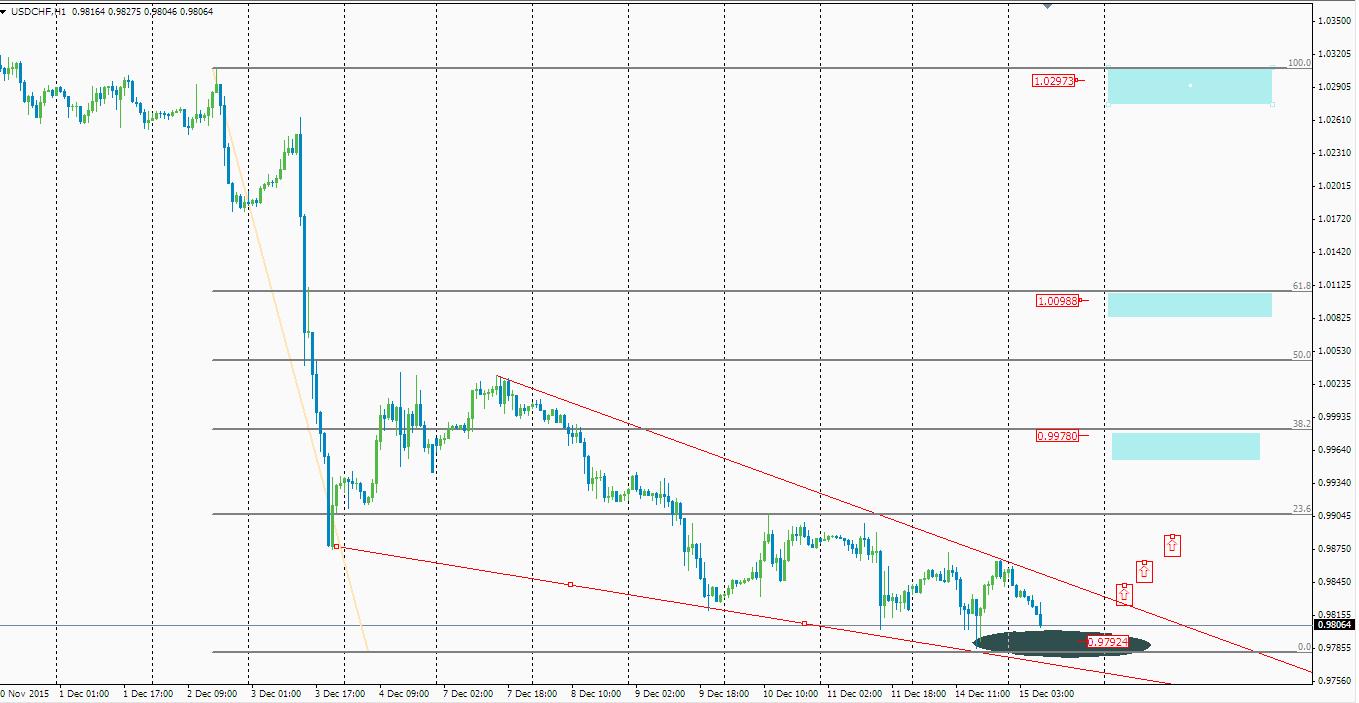
BUY CALL
ENTRY : 0.9800 TO 0.9755
SL : 0.9700
TARGET : T1 0.9865, T2 0.9905, T3 0.9978, T4 1.0044, T5 1.0088, T6 1.0175, T8 1.0245.
Technical levels for majors 11/12/2015
AS the day for US rate hike comes closer it is much more expected that the market would be in a tight range,
suggested technical levels for some of the major pairs are as follows
EUR/USD
| S3: 1.0828 | S2: 1.0855 | S1: 1.0882 | R1: 1.0988 | R2: 1.1016 | R3: 1.1043 |
GBP/USD
| S3: 1.5014 | S2: 1.5052 | S1:1.5090 | R1: 1.5183 | R2: 1.5220 | R3: 1.5258 |
AUD/USD
| S3: 0.7213 | S2: 0.7231 | S1: 0.7250 | R1: 0.7365 | R2: 0.7384 | R3: 0.7402 |
Market outlook 10/12/2015
The Kiwi Dollar rallied strongly following the RBNZ’s announcement that the Official Cash Rate (OCR) would be cut 25bps to 2.50%. However, instead of the bears rushing in and causing a sharp depreciation, RBNZ Governor Wheeler’s statement suggested that any further policy action would be unlikely in the near term.
Australia, as released by Australian Bureau of Statistics (ABS), surprised markets to the upside in Nov, with the unemployment rate falling 0.1 pts to the lowest since May 2014 at 5.8% against 5.9% seen in Oct. Markets had predict the unemployment rate to tick higher to 6.0% last month.
While participation rate increased 0.3 pts to 65.3% compared to expectations of 65.04%.
Employment increased 71,400 to 11,900,600. Full-time employment increased 41,600 to 8,205,800 and part-time employment increased 29,700 to 3,694,800. Unemployment decreased 2,800 to 739,100. The number of unemployed persons looking for full-time work decreased 9,400 to 517,400 and the number of unemployed persons only looking for part-time work increased 6,600 to 221,700.
ABS noted in its release, “incoming rotation adding to strong employment rise”
Major events to lookout for today.
London Interbank Offered Rate (Libor), Swiss National Bank (SNB)
BOE : MPC Official Bank Rate Votes
BOE : Official Bank Rate
US : Unemployment Claims